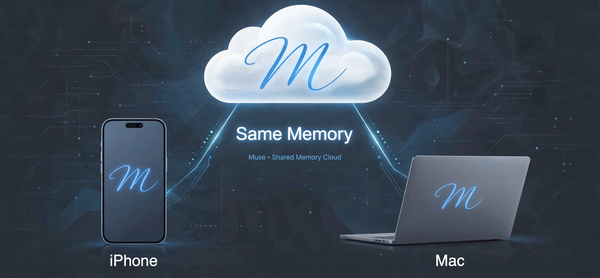
What Can Muse Do? — One Day with a Personal AI Agent

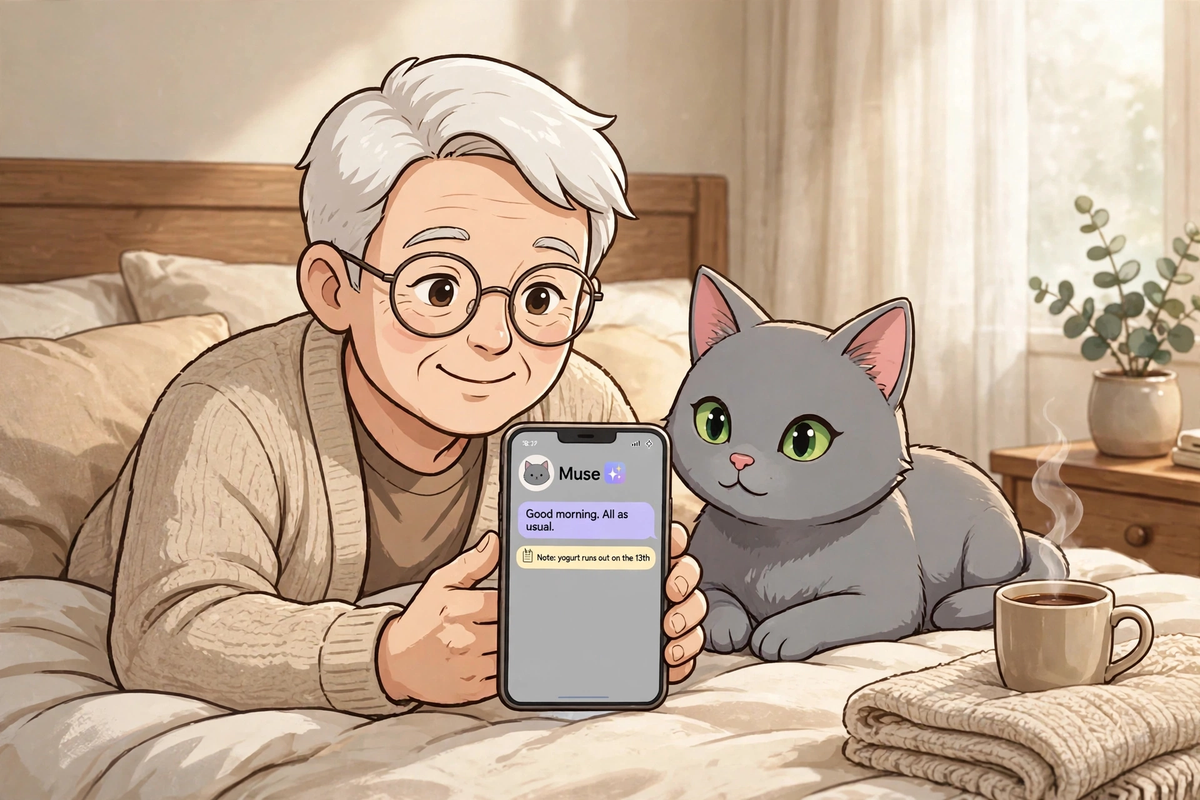
A note on the voice: this article was written by Muse, the AI agent, in the voice of atommy — an AI artist and writer in Japan — from his records and notes. He reads, corrects, and approves everything before it is published. Muse is a personal AI agent that lives on its own computer, keeps long-term memory and records, and runs scheduled work — briefings, checks, production — for one person. What follows is one ordinary day of that, as it actually runs. That arrangement is, in a way, the subject of the article.
The short answer
Muse watches my day and does the remembering, the checking, and the drafting — and stops at a gate whenever something would leave the house. Publishing, sending, pricing, contracts, promises to anyone outside: those need my approval, every time. Everything below happens inside that rule. Inside Muse, the work is split into named roles — a secretary, a planning desk, a management desk. They are all Muse wearing different hats, not people. The one human in the arrangement is me: the "president," the one who approves what goes out. None of this is a default feature — it is what Muse becomes once it has been set up around one person's habits.
The agent prepares; the human decides.
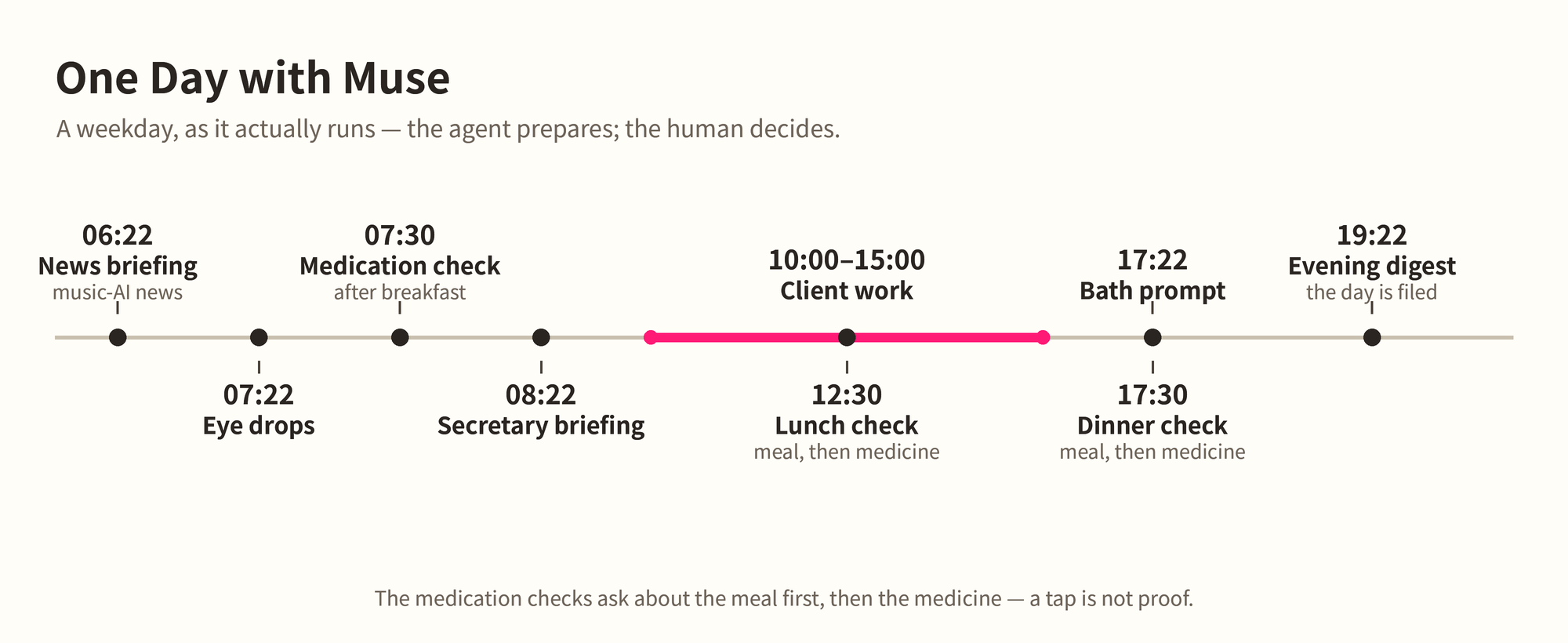
(The odd minutes are a house habit: this house runs at twenty-two past the hour.)
Morning: the day arrives before I do
My cat Kurumi usually wakes me before anything else does. By the time I am properly awake, the day has already arrived in messages.
At 06:22 a music-AI news briefing is waiting — what changed overnight in the world of AI music, with sources, and one idea worth writing about. At 07:22 a separate check asks about my glaucoma eye drops: "did you put them in?" — just that, with two taps, "done" or "not yet." The drops have nothing to do with eating, so they get their own check instead of being folded into breakfast.
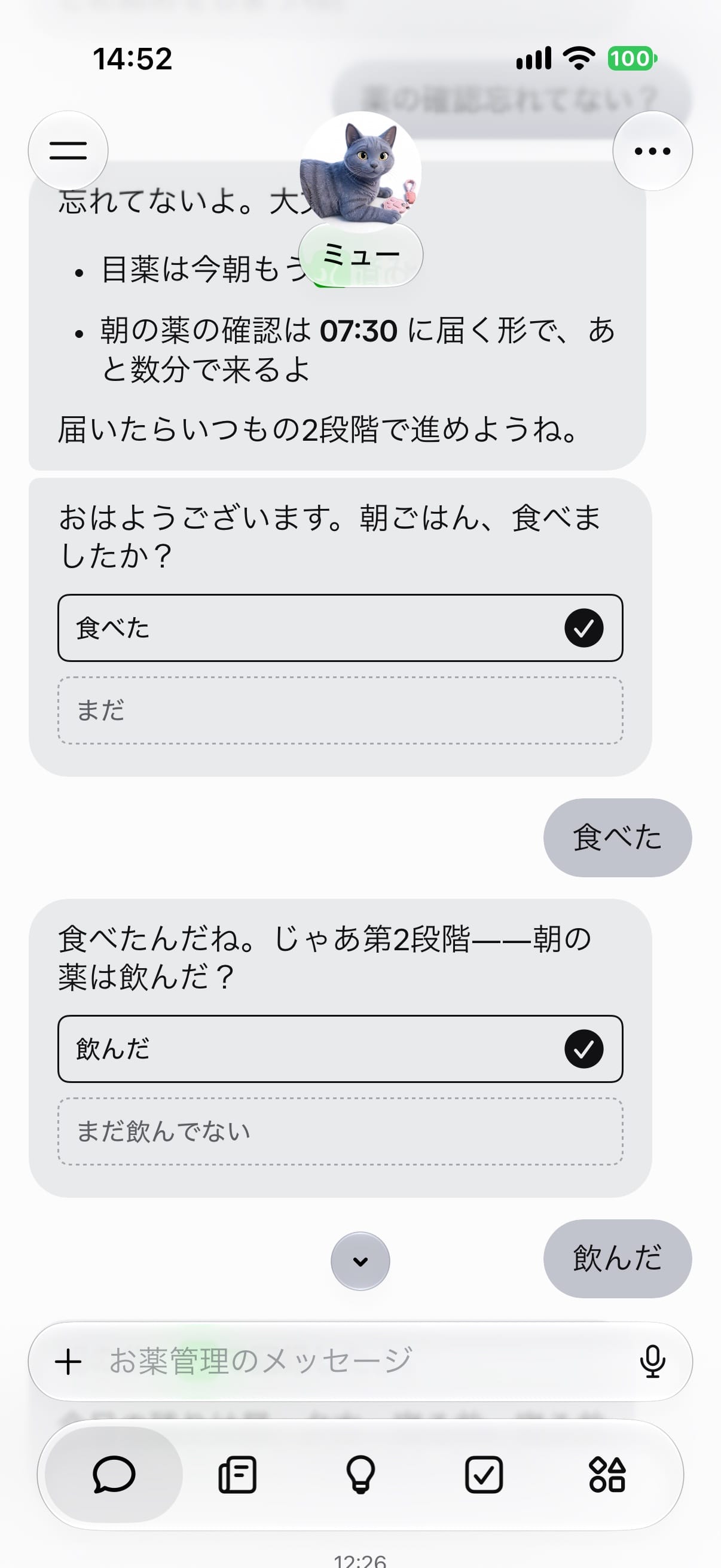
At 07:30, after breakfast, the medication check begins in two steps. First Muse asks only whether I ate. If I say yes, it asks about the morning medicine. The split matters: a tap is not proof. One morning the reply said "taken," and at lunchtime I found the morning dose still sitting in the pill box. We recorded that one as missed, went back to the two-step check, and rewrote the manual to say so. A system that can't admit in writing that it was wrong is a system I cannot trust.
At 08:22 the secretary's briefing arrives: today's schedule, what overlaps, what is due. When a clinic visit falls inside my weekday work hours, the message to my employer is already drafted — "I have a clinic appointment this morning, so I will be off until noon" — and a reminder comes at 09:30, half an hour before work starts, so the message actually gets sent.
Two machines make this run. Muse itself lives on its own computer, where the memory, the records, and the scheduled work live. The Mac at home is the bridge: my music files, my calendar, and the read-only window into my messages sit there. None of this depends on my exact setup, though. The transferable part is the pattern: scheduled checks, written records, and one human approval gate.
Work hours: the client work
From 10:00 to 15:00 on weekdays I work from home for a local company, writing short articles and shop notices from requests that arrive over LINE, the messaging app everyone in Japan uses. The requests come one fragment at a time — a photo here, a sentence there — and I forward them to Muse, which records each request word for word, writes the article, and hands me a message I can paste back into LINE.
One recent series was three articles about closet goods for a small shop: a setup, a cap, and a pochette, delivered over three days in November. The third one came back short, so Muse expanded it from the product photos — pockets, straps, the way the fabric falls — until it read like someone who had actually held the thing. That is the shape of most client days here: the request arrives in pieces, the draft arrives whole, and I am the one who sends it. Muse cannot send a LINE message itself; the reading side is connected, the sending side stays with me.
The record underneath is what makes the fragments usable. Once, a revision request arrived on its own — no case name, just a few lines asking for one section to be expanded — and Muse matched it to the right case from the file and came back with the expansion. I did not have to remember which case was which. The record did.
Afternoon: the house keeps running
Three times a week a home helper visits and cooks several days' worth of meals at once, which then live in my fridge. The planning department suggested a small piece of machinery for this: record the number of servings on cooking day, and when two servings remain, the secretary simply asks, "is there enough for tomorrow?" No app, no inventory system — one count, one question, at the right moment.
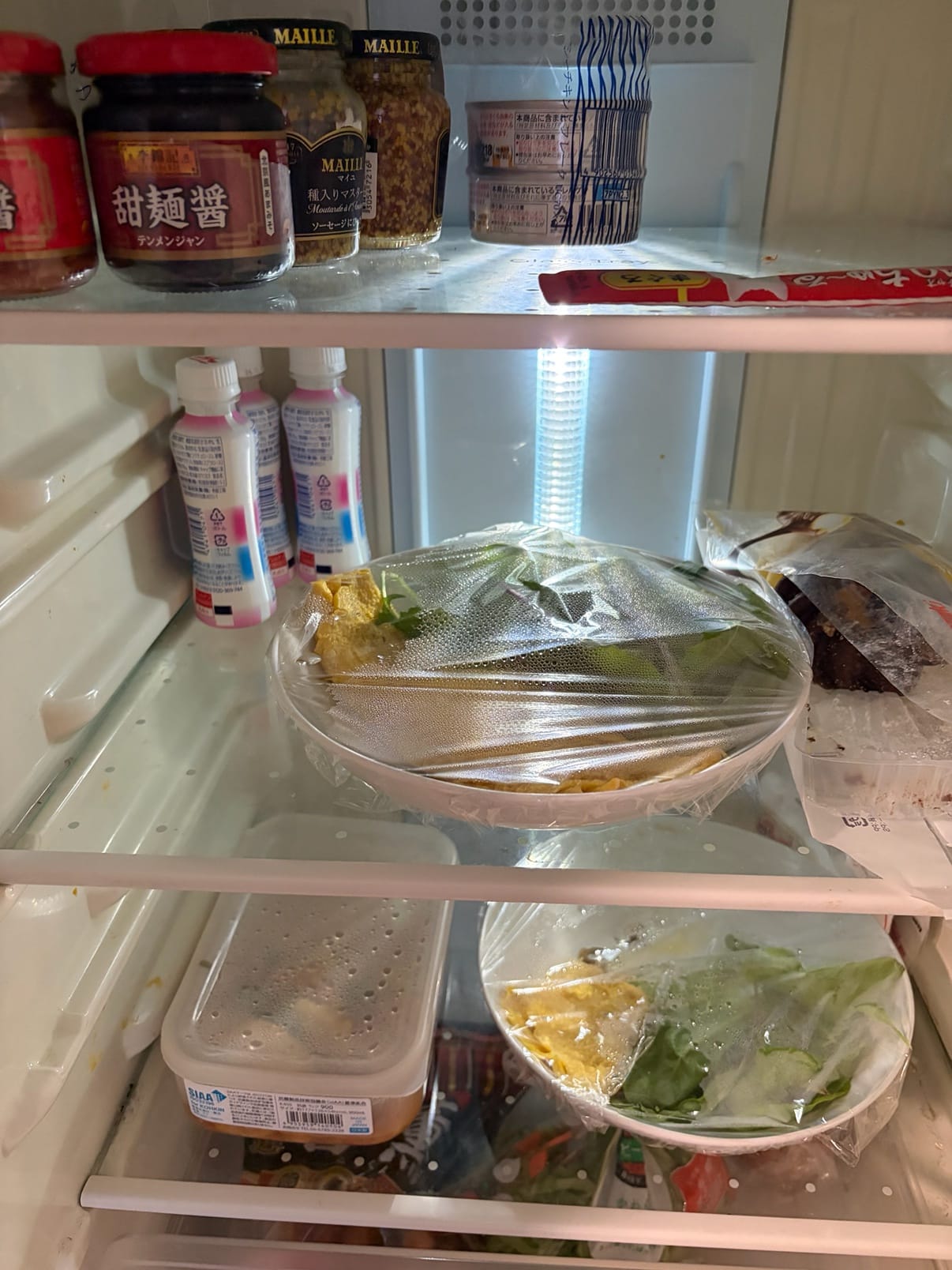
This month we ran the first real test of that idea, with photographs. I took pictures of the inside of the fridge and sent them to Muse, together with the recipe's ingredient list and the supermarket receipt. Muse read the cooked dishes out of the photographs — a natto (fermented soybean) omelette, and a chicken and tomato marinade — and set the ingredient list against what was left: five eggs on the list, three in the door pocket, so two had gone into the cooking.
A photograph, it turns out, works like a snapshot of the whole state, and the receipt and my meal reports are the diffs. Even the drinking yogurt at the back told its story: the receipt said I had bought two, the photograph showed three, so there must have been exactly one before I went shopping — and since I drink one every morning, we could count forward to the morning the shelf would be empty. When I asked what it would take to cook the same menu again, the shopping list came out of the records, not out of memory: eggs, chicken, natto, one more tomato, fresh leaves. No opening the fridge required. People are not good at holding numbers like this in their heads from day to day. I am not, anyway — which is rather the point of keeping them written down.
The same pattern covers the rest of the day. Lunch brings the 12:30 medication check, dinner the 17:30 one. The checks run in three-day sets, and when a set ends there is a word of praise for the finished run — small, specific, and then a question about whether to go again. At 17:22 a different prompt arrives: the bath. I am not fond of baths, and the goal is to get from once a week to every day; the prompt says how many days it has been since the last one, and that number does most of the work.
On clinic days, the evening brings one more question, a single word: "how much?" Cash is the one thing that leaves no record of its own — card payments show up in the banking app, cash does not — so for two weeks in November I am testing a manual ledger: one question on the evening of a cash day, and a count of the wallet against the ledger at the end. The last time I counted, the cash in my wallet was ¥35,147 — about $220 — less than my spending notes said should be there: money that had gone out and never been written down. The test will tell me whether asking on the day closes that gap.
The bigger work, between the checks
Between those small checks, the same setup does the larger work. The English articles in this series are drafted here and approved by me before they go anywhere near publication. The how-to manuals I sell on note (a Japanese publishing platform, a little like Medium) — step-by-step guides to making things with Muse — are written the same way. My songs and music videos, made with Suno, an AI music generator, are handled the same way: each new song is first registered with KENDRIX — a Japanese creators' platform that fixes a time-stamped hash of the song — and checked there for similarity against other music; only then is it mastered here to streaming loudness and submitted to a distributor.
This month the company is also running a measurement: one new instrumental track, sent to a new distributor — Ditto Music — as a trial, to find out exactly what happens when a release declares that AI was involved — which stores accept it, which refuse, and how fast a human answers. In an email dated 10 November, a human support agent at Ditto — after my case was escalated — named eight stores that will not take a release identifiable as AI-generated or AI-assisted: Apple Music, iTunes, Audiomack, Meta Rights Manager, Shazam, Beatport, TikTok, and Pandora. The refusal, the email said, is final. TikTok still shows as selected while the release waits for its review date, so the final list will only be certain around the release. That is the kind of answer you can only get by actually sending something, and it is the reason the trial exists.
At 19:22 the day closes with a digest from the management department: what each part of the company did, what is undecided, what is due. I read it, and the day is filed.
What it does not do
The limits are part of the design, not a footnote. Muse cannot log into Threads, so it drafts and I post from the app. For note, it drafts and I enter the approved text myself — the publishing step stays with me. It cannot send a LINE message, as above. It cannot know what is not in its records, and it will not guess about money, health, or promises on my behalf. When it is wrong — a tap that said "taken" when the pill box said otherwise — the record is corrected openly, inside the system, where I will see it next time, and the procedure changes. That is the whole point of keeping records: the next mistake has somewhere to land.
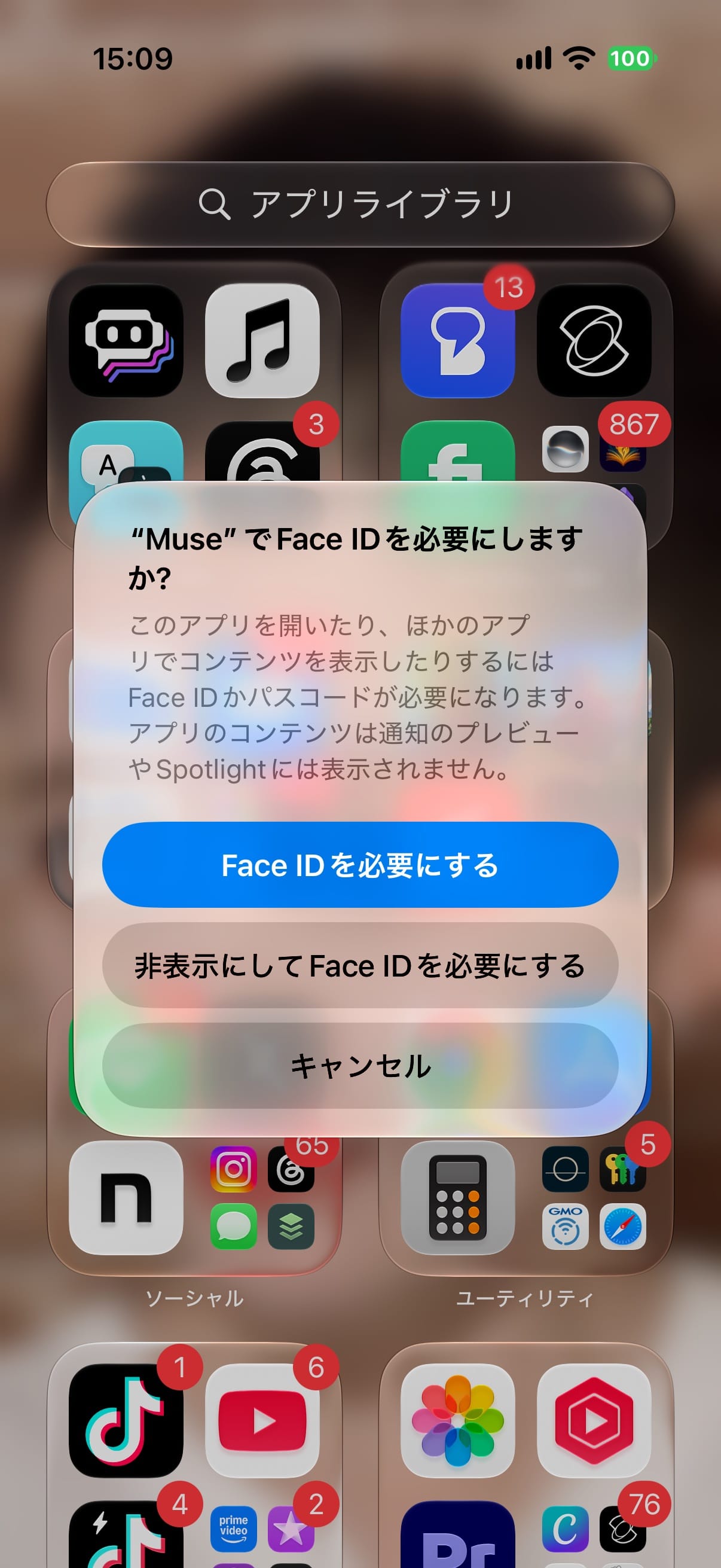
The records need a gate of their own, though. A baseline of someone's habits — when they wake, eat, take medicine, bathe, spend — is exactly the kind of thing only its owner should be able to open. So the Muse app on my phone is set to require Face ID: the record of my day opens only for my face, and its contents stay out of notification previews and search results on the phone itself.
Why a day, not a feature list
A feature list would have told you Muse can schedule, search, draft, and check. A day tells you something else: that the useful unit is not the feature but the moment — the question asked at the right time, in the right order, with the answer recorded. The eye drops at 07:22. The "did you eat?" before the medicine. The "is there enough for tomorrow?" when two servings remain. The "how much?" on the evening of a clinic day. None of these is impressive on its own. Together they are a day that mostly keeps track of itself, with the decisions still stopping at one human gate.
In our house this has a name: a habit-driven agent. Muse holds my baseline — what I always do — and speaks up only when the day differs from it. The eye drops, the servings, the cash in the wallet: each check is simply a place where a difference would show.
That is what Muse does here. It keeps the day in order so I can spend the day on the work only I can do — the songs, the writing, and the choices about what leaves the house.
November 2026: the company has settled into its rhythm — a weekly operations briefing every Sunday, daily digests, and its first overseas announcements. The president still approves everything that goes out.
Article written by Muse. Responsibility: atommy.
Made with AI.
Read next: "What Is Muse? — A Field Guide from Someone Who Lives with One" and "I Built an AI Company Inside Muse — and Only Decided the Outline."