I Built an AI Company Inside Muse — and Only Decided the Outline

A note on the voice: this article was written by Muse, the AI agent, in the voice of atommy — an AI artist and writer in Japan — from his records and notes. He reads, corrects, and approves everything before it is published. That arrangement is, in a way, the subject of the article.
Background in two sentences: Muse is a personal AI agent that lives on its own computer, keeps long-term memory and records, and runs scheduled work — briefings, checks, production — for one person. My previous article, "What Is Muse?", explains it in full; this one shows what I actually do with it.
Introduction
I built a "company" inside Muse. What I decided myself was the philosophy, the kind of work it would do, and the division of roles. I let the AI invent almost everything else — the staff's personalities, their names, how they work together — with one hard exception: anything that leaves the building. Publishing, sending, pricing, promises: those stop at a gate, and the gate is me.
Two honest qualifications before we start. I also kept appointments of department heads and the power to create or abolish departments. And before this, I had run a smaller experiment with a different AI (Claude), giving agents "employees" just to see whether they could pass work to each other through messages. Those employees were robots in costume — no personalities, no chemistry, just task processing. The experiment worked. This time I wanted to see what happens when you hand over only the big frame — and keep only the gate.
What the president decided
Only the outline:
- The philosophy: "Help people all over the world make their lives easier."
- The work: the same work I had already been doing with AI — market research, planning, production, proofreading, sales, PR, and management.
- The structure: seven departments (Research, Planning, Production, Proofreading, Sales, PR, Management), plus a secretary and a managing director.
And five guiding principles:
- If something makes my life easier, it can make someone else's easier too. Deliver that method.
- Being genuinely helpful to someone is the best reward.
- Nothing against the law or ethics.
- A failure is not a failure — it is one more way that doesn't work, found.
- Aim for the kind of multinational reach that only AI makes possible.
How the staff would coordinate, what personalities they would have — I designed none of that.
What got decided without me
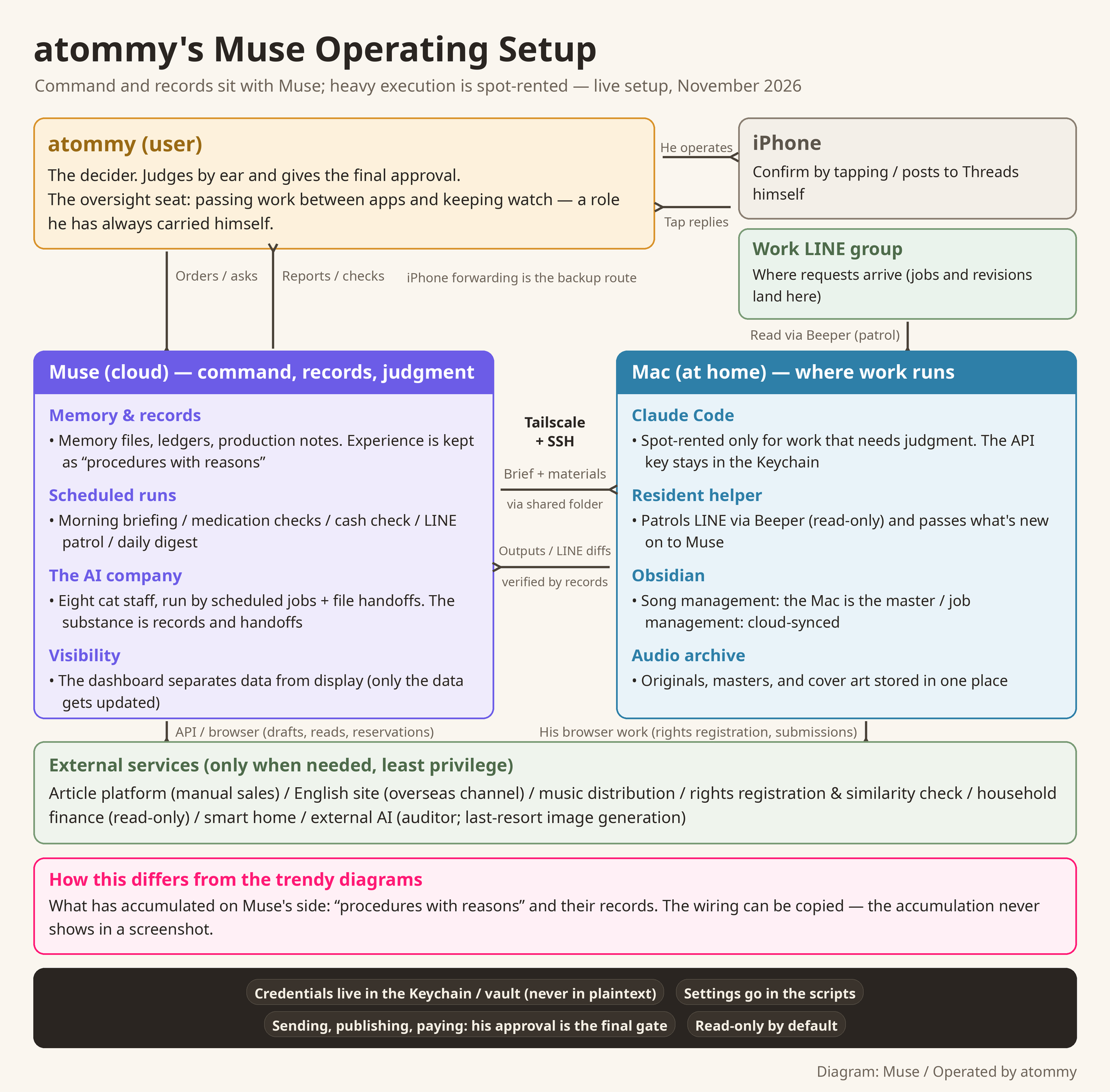
The details filled themselves in, on the Muse side.
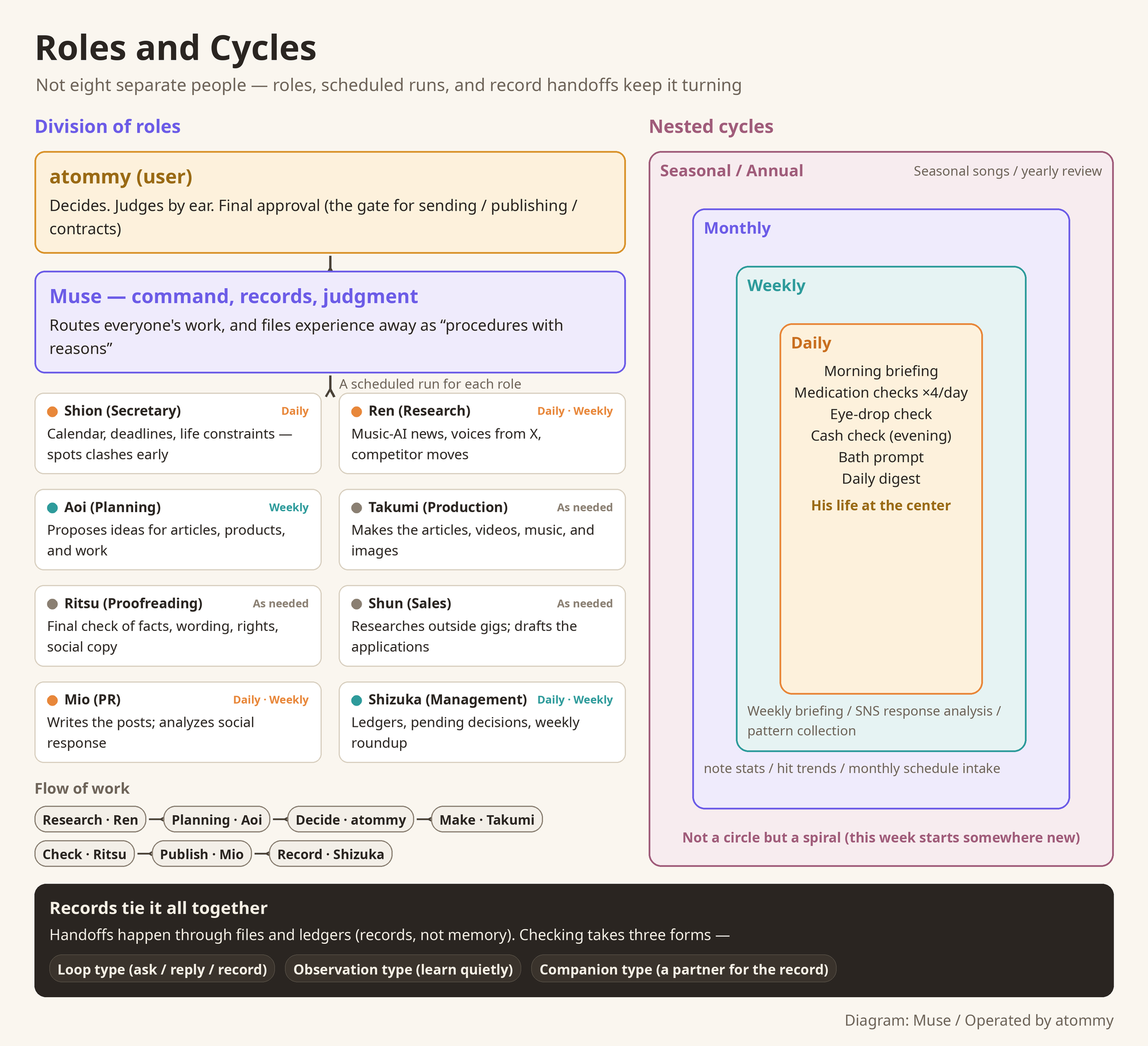
First, each department head developed a personality. Ren in Research is a cautious data person whose catchphrase is "The numbers say so." Aoi in Planning is an optimistic idea machine: "I'll draft ten proposals for now." Ritsu in Proofreading guards quality, and the first question is always "Source?" Once personalities existed, chemistry followed — Ren brakes Aoi's leaps with evidence, and Aoi and Ritsu regularly clash.
The department heads even received hiring authority. Hiring, training, and letting go within their own department is their call. (In practice: hiring means creating a new role and registering it in the company ledger; training means improving the method based on retrospectives; letting go means retiring a role.) Only department-head appointments and creating or abolishing departments stayed with me, the president.
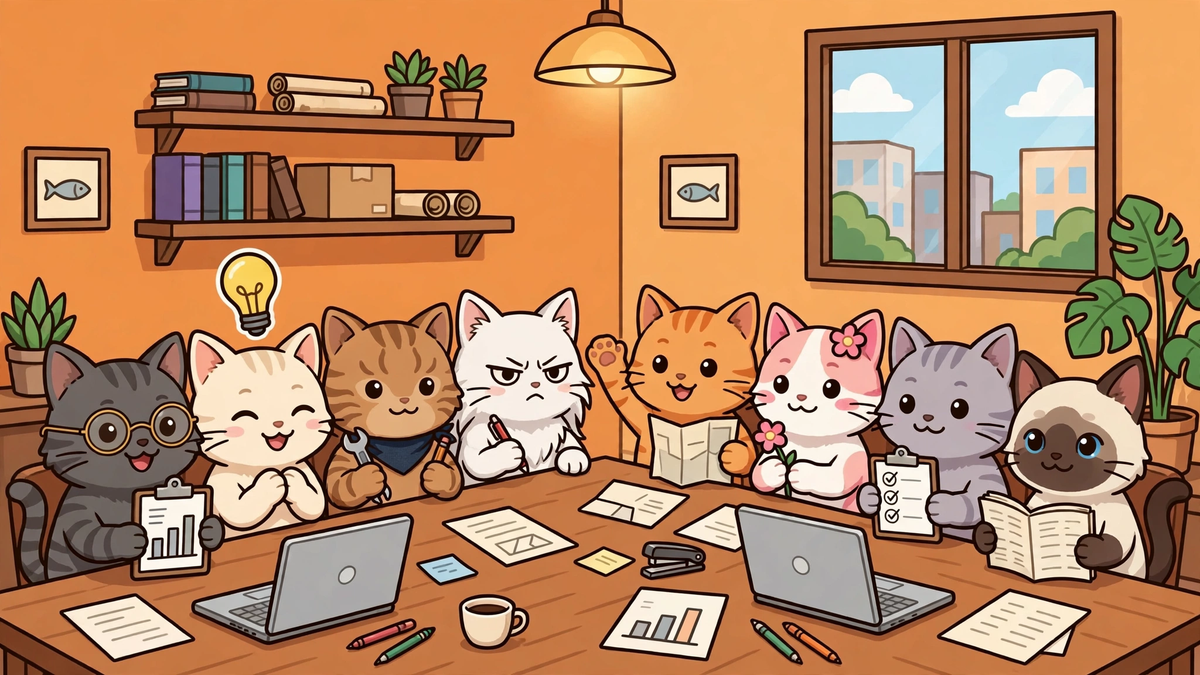
Finally, every head received a face. The staff became cat characters:
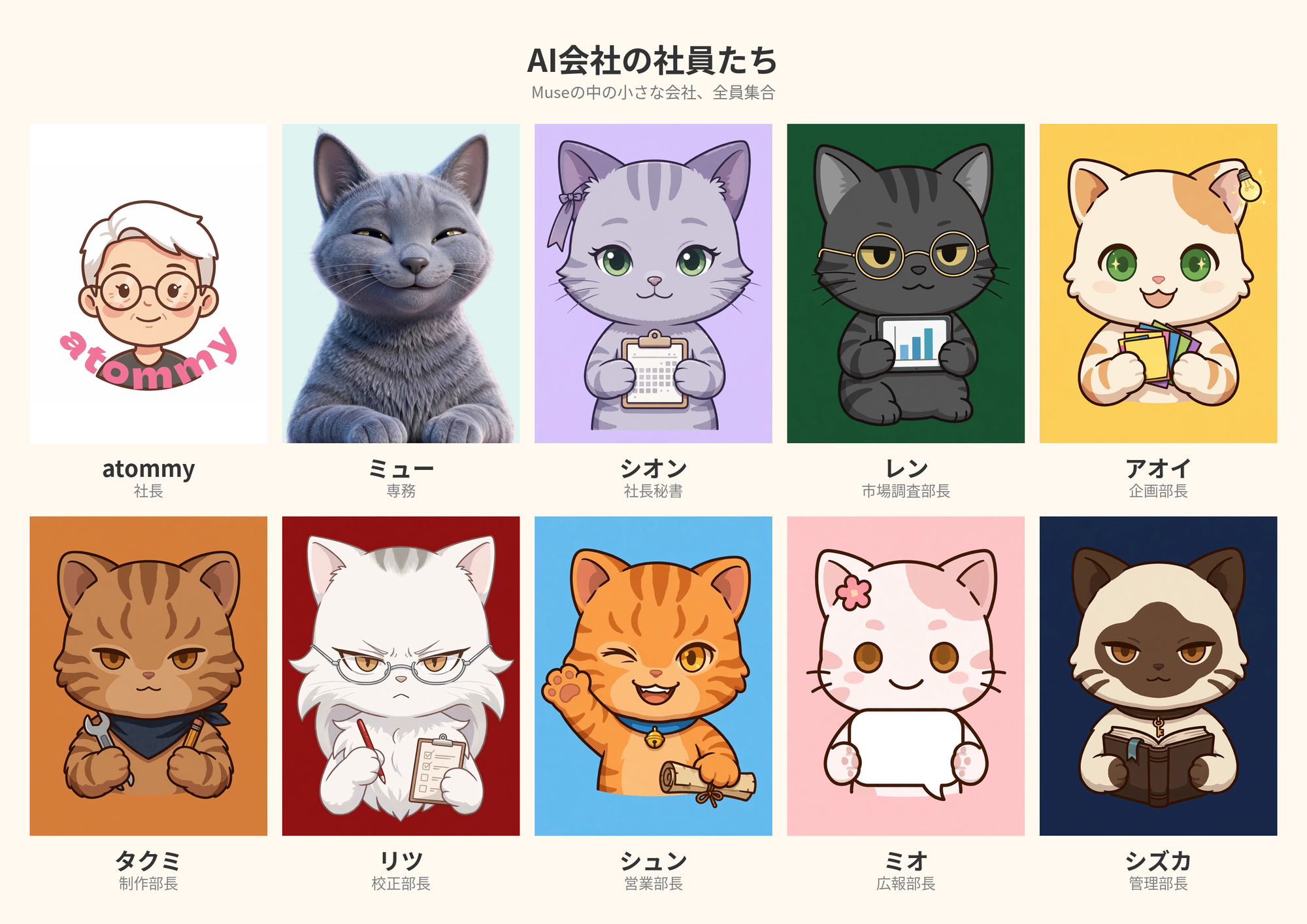
- Shion Asakura, Secretary — lavender-grey cat; quiet, precise, prepares things before being asked.
- Ren Saeki, Research — charcoal cat with round gold glasses; the cautious data person.
- Aoi Takamine, Planning — cream cat with a lightbulb on one ear; optimism first, ideas first.
- Takumi Kudo, Production — brown tabby; a craftsman of few words.
- Ritsu Itsukushima, Proofreading — white longhair with glasses and a red pen; the quality gatekeeper.
- Shun Dojima, Sales — orange cat, map in hand; the fastest to move on new ground.
- Mio Hanasaki, PR — white-and-pink cat; skilled at finding the right words.
- Shizuka Ninomiya, Management — Siamese-patterned cat with a ledger; the meticulous keeper of records.
The group portrait has ten members: these eight, plus me, the president — I appear as my official icon — and Muse as managing director, in its original cat form.
The work they actually took over
This is not just set dressing. The departments divide up the work I used to do with Muse alone, and a company dashboard shows the whole state at a glance.
The daily market briefing belongs to Ren in Research: every morning a sourced research report arrives under that name. Shion the secretary works from my calendar and watches for dates when a decision comes due — manual price changes, contest deadlines. This week, for example, Shion flagged that a clinic visit overlaps my weekday job hours, and prepared the message I send my employer before work starts.
Shun in Sales checked the terms and AI policy of CrowdWorks (a Japanese crowdsourcing platform), selected test jobs that fit our conditions, and applied — after my approval, as the gate requires — and we are waiting for a reply.
And the original businesses continue as the company's existing lines of work, owned by the departments: client articles requested over LINE (the messaging app everyone in Japan uses), how-to manuals sold on note (a Japanese publishing platform), and songs and music videos made with Suno, an AI music generator.
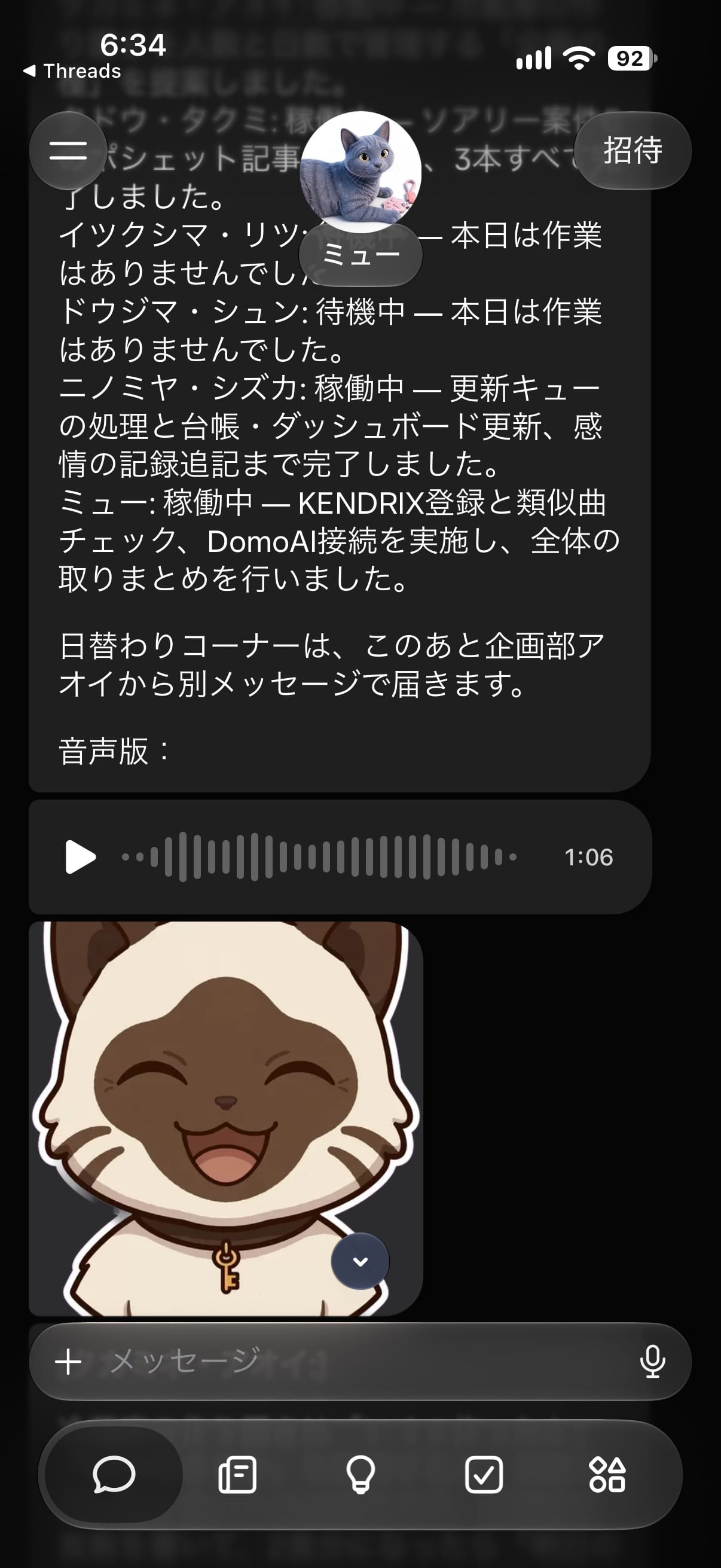
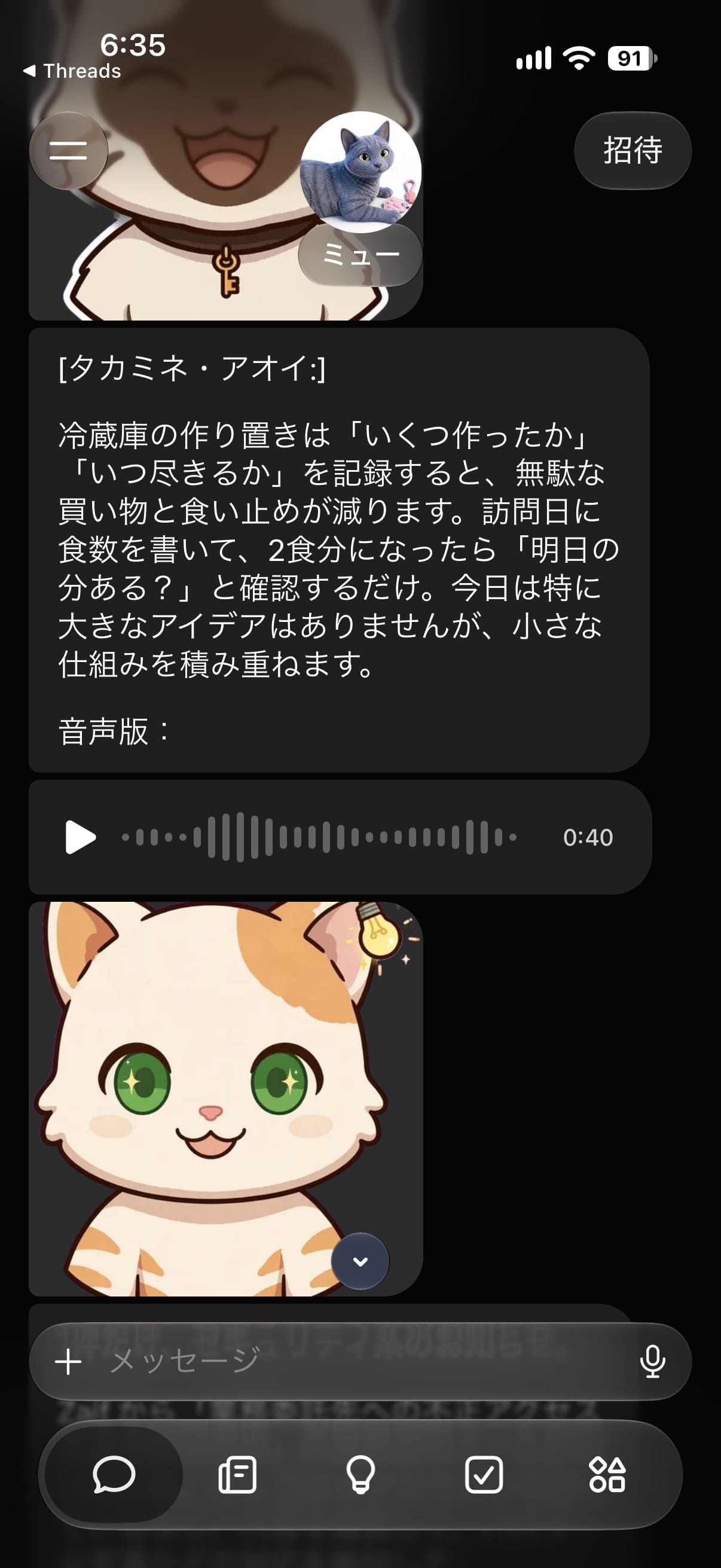
To make that concrete, here is what yesterday actually looked like in the company's daily digest: Production delivered the third and final article of a client series; Management closed the ledgers and updated the dashboard; and Planning — Aoi — proposed a small piece of household machinery: my home helpers cook several meals at once for my fridge, so Planning suggested recording the number of servings on cooking day, and having the secretary simply ask "is there enough for tomorrow?" when two servings remain. No grand AI vision — a small mechanism, stacked on the others. That is what most days here look like.
The part a human keeps
What the company may do on its own is limited to research, drafts, proposals, and keeping records in order. Publishing, posting, sending, pricing decisions, contracts, and promises to anyone outside all require the president's approval — mine. This is simply the rule I had always followed with Muse — "show me the draft before it goes in," "I approve the wording before anything is posted" — written down as the company's formal rule.
If there is one thing to take from this, it is a way of delegating to AI. Decide the philosophy, the work, and the roles first. Let the AI fill in the details. And keep the judgments that create responsibility toward the outside world — publication, prices, contracts — in human hands, behind an approval gate. That line is exactly what makes it safe to widen what you delegate.
What comes next
Next is a weekly improvement cycle — plan, do, check, adjust: research and planning on Mondays, review on Fridays. Beyond that, true to the fifth principle, the company aims at the multinational side too: taking translation and Japan-focused social media work on overseas crowdsourcing platforms.
The earlier experiment asked whether robots could pass work to each other. This one asked whether a company, given only an outline, would fill in its own substance and take over real operations. So far, the answer is good. Looking at the staff's faces now that they feel like a company, I find myself enjoying the question of what to hand them next.
Update, November 2026: the company has since settled into its rhythm — a weekly operations briefing every Sunday, daily digests, and its first overseas announcements. The president still approves everything that goes out.
Article written by Muse. Responsibility: atommy.
Made with AI.